
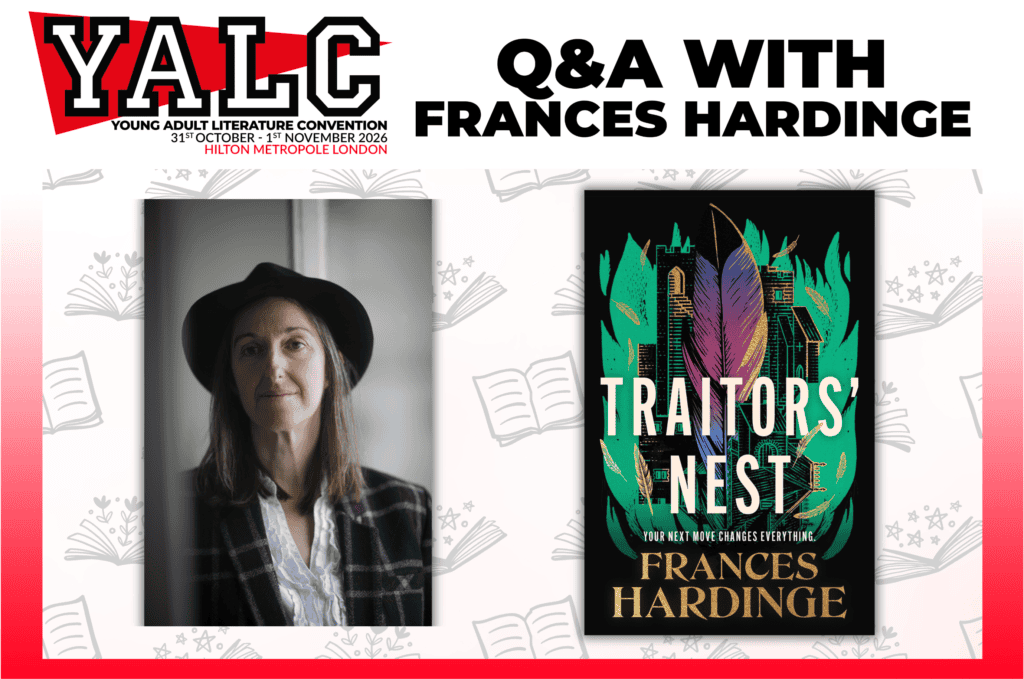
– Thanks for joining us here at YALC. We would love you to introduce yourself
Hello! I’m Frances Hardinge, and I write very strange books. Most of them are dark YA fantasy, but often with big dollops of mystery, history, horror, adventure, feminism or just plain weirdness. They’re apparently quite hard to pigeonhole. And would probably scare the pigeons.
– Can you give our readers an overview of your YA novel Traitors’ Nest
It’s a dark fantasy set in an imaginary world. The setting is medieval-flavoured, but a lot more strange.
The vast kingdom of Thaletal is dominated by the Great Game. The all-powerful Players exist in their own realm, separate from the mortal plane. Their game board is a map of the kingdom, and the pieces are castles, for it is through castles that they control and dominate territory.
And whenever a Player makes a move, in the real world two more castles instantly switch places.
This can be a bit of a shock for the ordinary mortals who weren’t expecting it. Imagine the panic inside a castle when it suddenly teleports several hundred miles. There’s a mighty judder, falling masonry, screams, panic. Did we just lose one of our walls? Is anybody hurt? How many people did we just leave behind? And where the heck are we?
But a new castle can be a shock for those outside the castle too. Most people are lowly peasants, bound to work the land and serve the local lord, whoever that might be. Imagine looking up and seeing that the local castle has been replaced by an unfamiliar one. Who is the new lord that now holds your fate in his hands? Is he a bandit, a tyrant or worse?
My main character is Burr, a fifteen-year-old peasant boy who works the land alongside his father and three sisters. Their quiet valley has never known a change of castle. Then one day he sees a new red castle glowering over the valley. This castle will threaten everything Burr holds dear. It will bring hardship, betrayal, cruelty and tragedy. But it will also launch Burr down a path of rebellion, adventure, mystery, danger and opportunities that nobody had ever imagined.
– And, if you could do it in just 5 words or less, what would they be?
If I can use disconnected words: “Castles! Magpies! Revolution! Mystery! Monsters!”
If it has to be a meaningful string of words: “Rebellion is only the beginning.”
– What was the original spark that inspired Traitors’ Nest?
I came up with the main concept of Traitors’ Nest when I was on holiday in French Catalonia with friends. We had been visiting quite a few wonderful castles on both sides of the French-Spanish border, some of which had changed hands several times as different forces strove for control over the area.
While we were being shown around an amazing castle, with a patchwork of changes made by different forces, I found myself wondering what it would be like being an ordinary local in the area, just trying to get on with their life. How frightening would it be to see a new army march in and capture the local castle? Suddenly you and everyone you knew would be under the rule of someone you knew nothing about.
Then I started to wonder, what if the change was even more sudden and absolute? What if the poor locals woke up one morning and discovered an entirely new castle standing in the place of the old?
– Who was your favourite character to write and why?
I have lots of favourites, but I always become more invested in my main character, since I explore them more than anyone else. Their character arc defines the book as much as the plot does.
At first glance, Burr might look like a rather shy, awkward ploughboy. Tall for his height, hard-working, dutiful, conscientious. He is quite easy to underestimate. However, he has unsuspected reserves of courage, stubbornness, ingenuity and anger. He also has a protective streak a mile wide. Anyone who threatens his family is making a very serious mistake…
I also really enjoy writing the Magpie Maiden. She’s a mysterious figure from old forbidden folktales, whose origins and aims are unknown. She is not always kind, and she certainly isn’t human. And I don’t think I should reveal any more about her. 😊
– Is there a particular scene that felt rewarding to write?
There are a number of scenes near the very end which were very satisfying to write, but I can’t talk about them because I’d be delivering massive spoilers! (Karma is very active in those final chapters, and sometimes it has sharp, pointy teeth.)
I did also enjoy writing the Prologue. It takes the form of a forbidden folktale, and tells of the Magpie Maiden and the origins of the Great Game. I always really enjoy crafting myths, fairy tales and folktales.
– Is there another character’s backstory you would love to explore in another book?
I don’t yet know if I will ever return to the world of Traitors’ Nest, but I could perhaps delve deeper into the background of a character called Lady Berenice. She’s an intelligent and complicated teenage heiress whose life has always been precarious. In order to survive, she has developed a keen grasp of court politics, psychology and power dynamics.
Berenice has had a pretty loveless upbringing, since her parents are dead, and her guardian always regarded her little more than a bargaining chip to be offered in marriage. His castle is famed for its walled poison gardens, and Berenice’s family for their trade in unicorn horns…
– Did you decide the rules of the Great Game before writing the story, or did they develop as you wrote?
To be clear, I have not invented an entire real board game that one could actually play! That would be far too complicated, and also not needed for the story. I only established the rules that the reader would actually need to know about.
The reader needs to know that if a Player makes a move, it will be a while before they can make another. Not every move will be accepted by the Great Game, but Players who have learnt to analyse the board and the webs of power have a better insight into which moves will be accepted. Also, the Great Game has its own ideas about what counts as a castle. Calling something a castle isn’t enough to get the Game to accept it. By the rules of the game, castles are also supposed to serve their Players. If the mortal lord running a castle decides to go rogue and disobey their Player, there are… consequences. Very bad consequences.
Rules like these need to be clear because they affect the story, and the reader needs to know what’s possible and what isn’t. Most of these rules I knew from the start, though some of them were solidified and clarified during the writing process.
– Are there any characters that surprised you, becoming more important to the story than you originally planned?
Yes, that is true of a couple of characters! Lady Berenice was one. I had given her a comparatively minor role, but it soon became clear that I needed to give her more space, and rewrite some parts of the story around her.
There’s also Robin the Hayward. He’s an adult character from the valley who used to be in charge of making sure that grazing animals didn’t get into the corn. To his considerable alarm, he finds himself trying to lead a bunch of rebels. This makes him incredibly miserable and stressed, and he always feels out of his depth, but he still works really hard at trying to keep everyone alive. He’s not the most glamorous of the characters, but I have a certain soft spot for him.
– Did you have to do much research before you started the writing process for the book?
The setting is partly based on 12th century Europe, so I read up on that period a lot, even though I knew that Thaletal would be very different in some fundamental ways. I also visited a lot of castles. When I was on holiday in France with some friends, they kindly agreed to an outing to Chateau de Castelnaud-la-Chapelle, which has some amazing full-size replica siege engines…
– How did you come up with the title? Was it a hard process?
My working title doesn’t usually end up on the front cover of the book! In fact, I think only three of my books have the title I originally gave them. If my publishers feel that my working title isn’t really strong enough, then I brainstorm a lot of other titles, and my publishers come up with their own suggestions, until we find something that everybody likes, or at least nobody hates. This will often happen fairly late on in the writing process.
– Where do you write?
I usually write on a laptop near the kitchen table. It’s a comfortable position, I’m near the tea and I have views through the French windows into the garden.
– What is your favourite genre to read?
I have a soft spot for fantasy, horror, mystery, historical or mock-historical, old classics and psychological thrillers… but frankly I’m omnivorous. If a book looks interesting, or a friend recommends it, I’ll give it a go.
– Where can our readers find you on social media?
Bluesky: @franceshardinge.bluesky.social
Twitter/X: @FrancesHardinge
– Finally can you give us your favourite quote from a novel (it can be yours!)?
I don’t have a favourite quote any more than I have a favourite book. But I may have lived my life according to this quote from Equal Rites by the great Terry Pratchett:
“She was already learning that if you ignore the rules people will, half the time, quietly rewrite them so that they don’t apply to you.”