
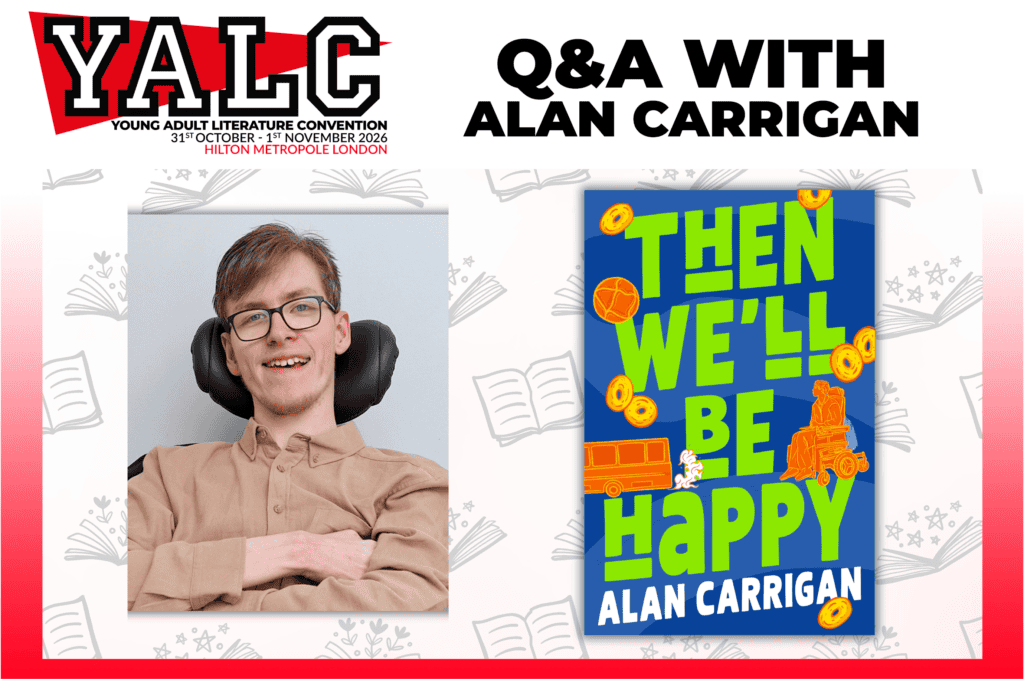
– Thanks for joining us here at YALC. We would love you to introduce yourself
Thank you for having me. My name is Alan Carrigan. I am an Irish novelist and screenwriter who has quadriplegic cerebral palsy, and I’m currently interested in writing the representation that I needed, but rarely saw growing up.
– Can you give our readers an overview of your YA novel Then We’ll Be Happy?
Of course! Then We’ll Be Happy follows Sam, a 17-year-old student who, due to an inaccessible bus, is missing out on yet another school trip. So, he takes matters into his own hands and starts a fundraiser. He teams up with some unlikely people along the way who are all chasing their own version of what they think will make them happy.
– And, if you could do it in just 5 words or less, what would they be?
Once you succeed, then what?
– What was the original spark that inspired Then We’ll Be Happy?
The novel is set during transition year, which, for the non-Irish readers, is a gap in the Irish school system which comes between two exam years. It’s a transitional period where you go on lots of school tours and just have a break between exams. I had a great time during my transition year, and getting to go on the school bus with everyone else was a huge part of that for me, so the idea came from thinking about what it would be like if TY wasn’t as accessible for someone as it was in my experience.
– Who was your favourite character to write and why?
Aimee and Saoirse were quite fun to write. They’re very confident girls when we first meet them, but without giving too much away, I think through their comedy they also deliver a lot of the heart.
– Is there a character that you relate to?
With the exception of Ben and his mum, who are just vile, there’s a little bit of me in everyone, I think. But everybody’s a lot more confident than I was at 17. I’m getting to the point now where I am really comfortable in who I am, so I would say I’m a mix between Dave and Brendan.
– Is there a particular scene that felt rewarding to write?
In chapter 15, Aimee has some big news to share. As I was writing the dialogue, I got to pay off a throwaway joke from earlier in the book. I didn’t expect it, but when I realised I had the opportunity for her to make a callback to a very specific skill that she has, I knew I had to include it.
– Why did you use Sam, being excluded from the school trip to push him to his tipping point?
I wanted to set the novel in transition year in an Irish secondary school. Transition year is all about school trips. You have to pay for the year upfront, and if somebody paid for transition year and couldn’t go on the tours, I imagine they would be pretty pissed off. It’s not about one school trip. It’s about the implications that it has for the rest of the year. If Sam doesn’t do something in that moment, he could potentially be wasting a whole year of his life.
– Did you always plan for Sam and his bullies to develop an unexpected relationship?
Yes, before I even knew it was a novel, the nugget of the idea was to put a person who has been disabled their whole life in a situation where they have to work with somebody who has become disabled. I wanted to explore the idea that even though Sam has been in a wheelchair his whole life, he has just as much, if not more, to learn than the newly disabled Patrick. I wanted to show that being comfortable with your disability means not only finding comfort in your physical ability, but the way you process things internally as well. And when I paired that with my idea to write a school story, the friendship just grew from there.
– Did you have to do much research before you started the writing process for the book?
Technically, no, as when I started writing the book, I didn’t plot at all; however, once I got past the first few chapters and realised that if I was going to include a character like Aimee who is in institutional care, I couldn’t just wing it. So, I asked sensitivity reader Geraldine Lavelle, who has lived experience being in care, for help; based on her advice, I then reached out to people in the national rehabilitation hospital, along with other people with lived experience to craft those characters. Once I did a bit of research, I realised the importance of plotting and thanks to my wonderful editor and all my creative writing teachers, I went back and plotted the entire story, which helped a lot.
– Were there any parts of Sam’s story that were particularly personal or difficult for you to write?
With Sam’s story in particular, I think the hardest bits for me to write were the emotional scenes. I wrote the majority of the book through voice recognition, so a lot of it was me acting out what I think the characters would do, but when you’re experiencing a heightened sense of emotion, it’s hard to articulate what you’re feeling, so, I had to write the scenes more traditionally so that I could be conscious of getting the right emotion across, but also, from a mechanical point of view, make sure the chapter lands the way it’s supposed to.
– Which part of the story do you think changed Sam the most?
It’s very hard to answer that without spoiling the book, but there is a power chair football scene towards the end of the book where he has a lot of internal revelation. I also think that revelation morphs a bit as we go into the third act, so depending on how each individual reader perceives it, that could also be the biggest turning point.
– How did you come up with the title? Was it a hard process?
The original title was The Wheels in the Bus, but because it was too similar to the nursery rhyme, I had to change it. It was for the best anyway, as the more the story evolved, the less it became about the fundraiser and the more focused on the individual happiness of the characters, hence the name change. I wrote out a list of about 20 titles, and this is the one that stuck.
– Where do you write?
I mostly write using voice recognition, so usually in front of my computer or wherever there’s a quiet space. It’s not very aesthetic, but it gets the job done.
– How did your own experience of living with cerebral palsy influence Sam’s experience?
Sam’s physicality is a version of my own, although I have tweaked how his body and muscle tone might react in certain situations based on what I needed for the story. If anything, some of the realisations Sam has throughout the novel, like what the social model of disability is, are things that I didn’t realise until after I left school. Even as I was writing, the characters and the people I interviewed taught me so much.
– How important was it to you to include a character with cerebral palsy?
Incredibly important. People with CP exist in the real world, so why shouldn’t they exist in the fictional one also? I know there are a couple of portrayals of CP in media, but none that reflected the Irish experience, at least from what I saw growing up, so I decided to write one, and hopefully more writers and stories will follow if they are not already.
– How important was it to show Sam as more than just a character with a disability?
Majorly important. Sam is a person, and people are complicated. Oftentimes people with disabilities and media portrayed as one note plot devices, and I, for one, was hungry for a more three-dimensional approach.
– What is your favourite genre to read?
I love a good rom-com. I also quite enjoy fantasy, but mostly I don’t read according to a specific genre. I read based on characters’ voices.
– Where can our readers find you on social media?
You can follow me on instagram @alancarrigan, or go to my website alancarrigan.com
– Finally can you give us your favourite quote from a novel (it can be yours!)?
I can’t turn book pages, so I usually listen to audiobooks as I’m winding down for the day. As a result. I don’t really remember quotes, but I remember how I feel when I read them. One of my favourite authors of recent years is Elle McNicoll, and when I was looking through quotes to include here, I found this one, which I think is pretty fitting!
“Books are not medicine, they are food. You won’t remember every bite, but you will remember the taste.”
― Elle McNicoll, A Kind of Spark
THEN WE’LL BE HAPPY by Alan Carrigan is out now in paperback (£8.99, Chicken House)