
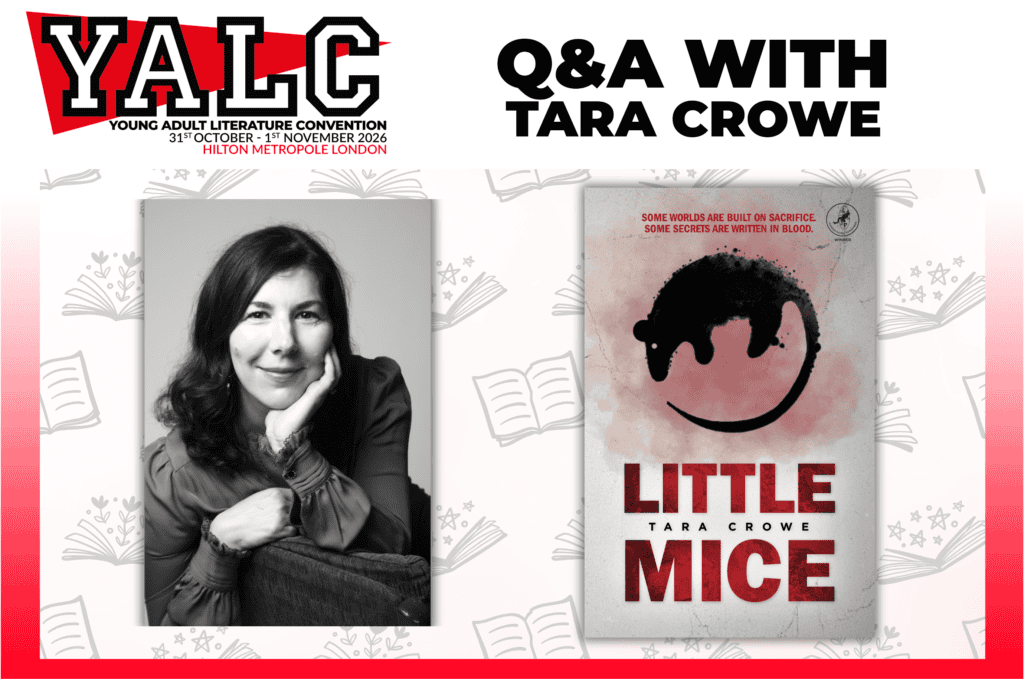
Thanks for joining us here at YALC. We would love you to introduce yourself.
Hello, I’m Tara Crowe, a debut author of dystopian fiction. I live in South London with my family, and my novel, Little Mice, has just been published by Leapfrog Press. It will be the first book in a trilogy.
Can you give our readers an overview of your YA novel Little Mice?
Little Mice is set in a speculative future where the rich stay young using blood plasma taken from the poor. Seventeen-year-old Astra Fairwood has grown up in a luxurious skyscraper city called the Canopy Complex. Her life is one of parties and privilege, and she’s never questioned the segregated system of their society. But when her powerful father is murdered, she is cast out of the Canopy Complex and sent to the Donor Zone, the very place she was raised to fear. It’s a riches-to-rags story that is part coming-of-age, part rebellion, part romance, and part murder mystery.
And if you could do it in just five words or less, what would they be?
Murder, blood, exploitation, rebellion, love.
What was the original spark that inspired Little Mice?
The science behind Little Mice is real, and I was listening to the radio when I heard a news segment – scientists studying ageing were taking blood plasma from the young and transfusing it into older people. (These human trials followed decades of experiments on mice, where they were cut and then sewn together while still alive!)
So immediately, I found the idea both intriguing and alarming. Could blood really hold the key to ageing? And I think the concept struck me all the more because at the time I was working for a company making collagen supplements. We were running a double-blind, placebo-controlled clinical trial, so I was already fascinated by the science of rejuvenation. The increasingly clever ways we can trick the body into looking and feeling younger.
But these plasma experiments were on another level, and (unlike collagen which is derived from animals or fish) needed human donors. So far however, the most striking results have been in mice. Older mice, after receiving young blood, developed thicker fur, became more agile and showed improvements in cognitive function. They even lived longer. But I couldn’t help but wonder what would happen if the science was proven to work for humans too. What would happen if we were ever able to do it at scale? What happens when youth itself becomes a commodity: extracted, priced, bought by those who can afford it and somehow sourced and sold, willingly or not, by those who can’t…
Who was your favourite character to write and why?
My favourite character to write was Astra’s older sister Lucile, who is manipulative and selfish. I always enjoy writing the bad characters, because they get the best lines in dialogue.
Is there a particular scene that felt rewarding to write?
I think the scene when Astra finally faces up to the truth – that the world she was raised to accept is wrong. I think in life many of us blindly absorb what we are taught as children, but as we grow up, it’s vital to question what we’ve been told. With Astra, I imagined a chasm opening in her mind, so all her childish beliefs tumbled out.
Did you have to do much research before you started writing the book?
Yes, I fully fell down a rabbit hole, googling plasma experiments and researching how the plasma donation system might work. My main character, Astra, has a rare blood type which is found in only about 4% of the population. But this blood type makes her a universal plasma donor which is an integral part of the story.
How did you come up with the title? Was it a hard process?
Yes! Originally, I had a different title – ‘The Blood Laws.’ Unfortunately, a quick online search made me realise that too many books already existed with the word ‘blood.’ So I tried to think of an alternative. Then I hit upon ‘Little Mice’ one day, and it seemed perfect. In the book, every child grows up with the founding myth – the story of two little mice sewn together a hundred years ago. But the title also ties in with the idea of people who are small, overlooked and used.
Did you always know how the story would end, or did it change while you were writing it?
I had the climax scene to Little Mice in my head (where Astra finally learns who murdered her father) from pretty much the very beginning of the writing process. However, when I won the Leapfrog Global Fiction Prize, I received feedback from the judge about how the book wraps up after the climax scene, and I incorporated that into the book, as it nicely sets up the dynamics of book two.
Why did you choose to make Astra the daughter of the Chief Enforcer?
I wanted to write a riches-to-rags tale – almost a reverse Hunger Games – so I knew Astra would be the daughter of someone wealthy. Making him the Chief Enforcer meant Astra wasn’t just rich, she was the daughter of the man responsible for upholding the system. So when she ends up on the other side of it, the fall is as far as it can possibly be, and she also has to face the uncomfortable question of what her own family was part of.
How did you come up with the world in which your book is set with all the rules etc?
Straight away, I knew the society in Little Mice would be extremely unequal. It had to be, for one group to be so grossly exploited by another. But it’s also the trajectory we’re already on. Inequality is becoming more entrenched: the rich are getting richer, and the poor are getting poorer, and AI is likely to exacerbate this divide further.
So I started with the economics: who has power, who pays for it, and how the system keeps people in their place. From there came the glittering towers of the Canopy, then the mainland, where workers are scheduled by an algorithm, and finally the Donor Zone where Gratitude Guides cheerfully remind everyone that ‘Giving is good.’ I wanted the cruelty to feel polite and bureaucratic, because that’s often how it works in real life.
What do you hope the readers will think about Astra’s choices at the end of the book?
I hope they argue about them! Astra isn’t a perfect heroine. She makes mistakes, and by the end she’s in a position where her choices are limited by the powerful people around her. I’d love readers to put themselves in her shoes and ask what they would have done.
Where do you write?
I write in my bedroom. I have a tiny sofa by the window, and I sit there with a laptop on a cushion. I love being by a window, with the natural light coming in.
What is your favourite genre to read?
I love so many genres. Obviously, dystopia is a big one for me, but I also adore historical settings, alternative history, time-slip, and a good old epic family saga.
Where can our readers find you on social media?
You can find out more at littlemicetrilogy.com, and I’m @taracrowewrites on Instagram & TikTok.
Finally, can you give us your favourite quote from a novel (it can be yours!)?
I think my favourite quote from a novel is the last line of The Great Gatsby. I love the lyrical language and the alliteration, as well as the deeper meaning.
“So we beat on, boats against the current, borne back ceaselessly into the past.”
LITTLE MICE by Tara Crowe is out now in paperback (£10.99, Leapfrog Press)