
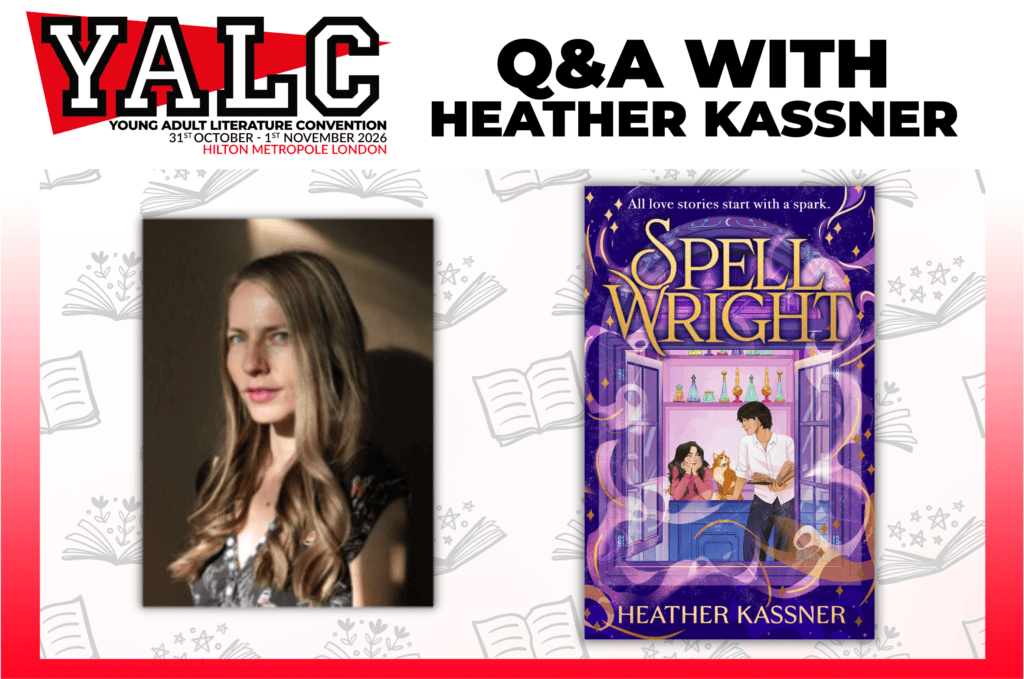
– Thanks for joining us here at YALC. We would love you to introduce yourself.
Thanks so much for having me! I’m Heather Kassner, and I write young adult and middle grade stories woven with magic, whimsy, and spider-silk threads of darkness. When I’m not writing, I’m reading, snapping photos of hummingbirds, or taking walks (and wishing I was in a forest).
– Can you give our readers an overview of your YA novel Spellwright?
Spellwright is a cozy romantic fantasy about a dust-fingered spellwright and a frustratingly charming (and rather sleepy) magician in search of a dangerous grimoire.
– And, if you could do it in just 5 words or less, what would they be?
Curses and magic-dusted kisses
– What was the original spark that inspired Spellwright?
When I was brainstorming story ideas, I really wanted to write something magical and playful and romantic. I wanted to forget about the real world for a little bit. And then, quite like Fia’s gold dusted magic, the idea popped into my head—of a girl searching for her late mother’s missing spellbook.
– Who was your favourite character to write and why?
They were all so fun to write, but most of all, I loved writing the scenes with Fia and Penbrook. Penn in particular always put a smile on my face—his sleepiness, his teasing contrasted with his seriousness, his illusions, and his vulnerability, which he was hesitant to show anyone. Until he met Fia.
– Is there a character that you relate to?
I relate most to Fia. She’s rather quiet, but when she’s around those she knows and loves, she comes out of her shell. She’s also dealing with her mother’s untimely death, and I lost my dad while I was writing this story. So much of my own grief found its way into Fia’s heart.
– Is there a particular scene that felt rewarding to write?
There’s a small scene that means so much to me, and though I teared up while writing, it felt like a balm. Fia misses her mother so much and thinks about how she’ll never hold her hand again. All she has left are the things her mother last touched. So she takes the glass doorknob off her mother’s bedroom door, not wanting anyone else’s fingerprints to overlap her mother’s.
When I lost my dad, my sweet aunt took my dad’s glass doorknob for me—a small thing that I will always cherish. So I gave a similarly heartfelt moment to Fia.
– Is there another character’s backstory you would love to explore in another book?
Oh, if I had the opportunity to explore another character’s story, it would have to be Andromeda Dahl! She was a delight to write, and she definitely has much more to say. I see an adventurous future for Andromeda, filled with magic and curses and boys falling at her feet—and maybe one special someone who finally steals her fickle heart.
– Was there a character that changed the most from your first idea to the finished book?
I tend to get to know my characters more as I write them, so no one is so cemented in my head that they can’t change as the story progresses. In fact, I love when my characters surprise me!
– Did you have to do much research before you started the writing process for the book?
Although I didn’t do any research before I started writing Spellwright, I did do quite a lot of brainstorming. That’s one of my favorite parts of the writing process—letting myself indulge in all the possibilities, dreaming up characters and scenes, considering which of my favorite things I might weave into the story.
– Did you know the ending from the beginning, or did the story change while you were writing it?
I did know the ending of the story from the beginning. In fact, even though I usually write in order, I wrote the Epilogue sometime earlier. I just had such a clear picture of the final scene. And when I wrote the last line, I remember smiling (and giggling to myself), feeling as though everything had settled right where it was meant to be.
– When did you first realise you wanted to become a writer?
Ever since I fell in love with reading—when my mom or dad or gram tucked me in bed with fairy tales—I wanted to write stories of my own.
– How did you come up with the title? Was it a hard process?
The title actually came to me at the story’s inception. I was daydreaming about spellshops and magic and a girl with golden dust at her fingertips. I wondered what kind of magic she might wield, and that’s when it struck me—that she wrote spells. Thus Spellwright.
– Where do you write?
Although I have an office, you’re just as likely to find me there at my desk as you are to find me curled up on the couch or in my bed. I love being cozy, and yes, I mostly write in my pajamas! No matter where I write, though, my cats are always nearby.
– What is your favourite genre to read?
I read fairly widely—both in genre and age category—but I gravitate toward fantasy. I love being whisked away from the real world and wandering around in a place I’ve never explored before. Please give me all things magical, whimsical, and dark. Some of my favorite books include:
YA: An Enchantment of Ravens by Margaret Rogerson & Gallant by V.E. Schwab
Adult: Honeysuckle by Bar Fridman-Tell & The Night Circus by Erin Morgenstern
Middle Grade: Eden’s Everdark by Karen Strong & The Dollmaker of Krakow by R.M. Romero
– Do you have any advice for any young writers?
When I was younger, I loved writing, but I never managed to finish anything. A new, sparkling idea always seemed to draw me away to the next thing. But when I finished my very first book (The Bone Garden), I was so fizzy with excitement! Writing The End was the very best feeling. So if you have a story you love, my advice would be to finish it, and do your best to resist the temptation of shiny new ideas. Jot those gems down, and they’ll be there waiting for you when you’re done.
– Where can our readers find you on social media?
I’m on Instagram—mostly posting about my books and my cats: @heather1ee
– Finally can you give us your favourite quote from a novel (it can be yours!)?
One of my favorite quotes from Spellwright is:
“She’d almost forgotten how very much better life could be with a sprinkling of frivolous joy.
Even when—especially when—things were at their worst.”