
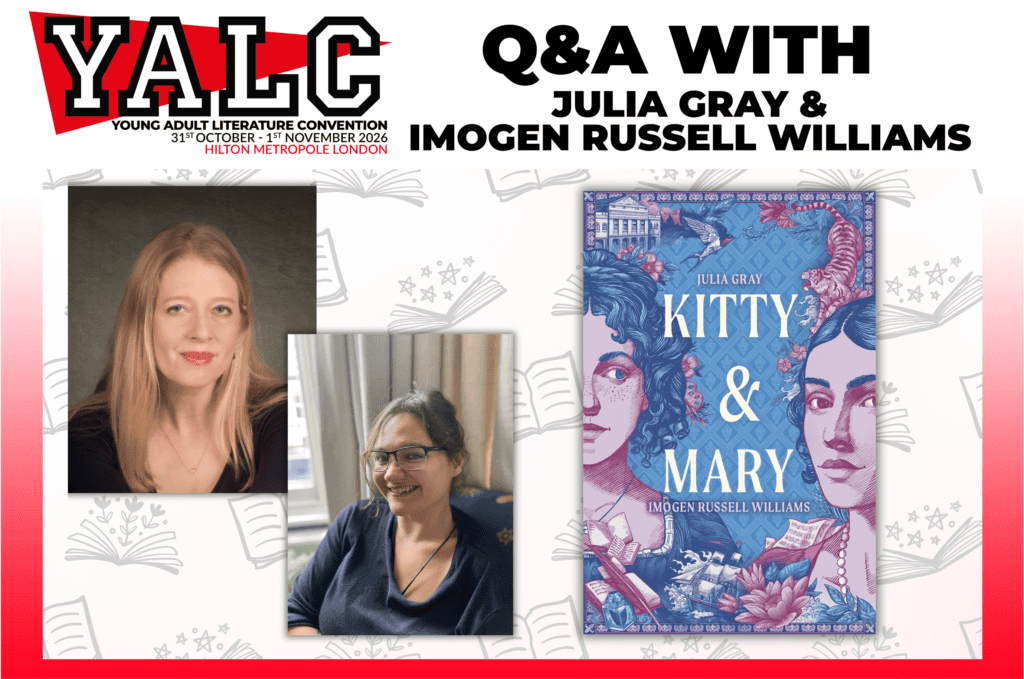
Thanks for joining us here at YALC. We would love you to introduce yourselves.
(Julia) I am the author of three YA novels and occasional singer-songwriter (I also write picture books sometimes). (
Imogen) I review children’s books and YA for The Guardian, and I write poetry and children’s non-fiction when I’m not co-writing with Julia!
Can you give our readers an overview of your YA novel Kitty & Mary.
Set 6 months after the end of Pride and Prejudice, our novel imagines what might have happened next for Kitty and Mary, the two Bennet sisters who remain unmarried at the end of the original book.
And, if you could do it in just 5 words or less, what would they be?
What followed for Kitty and Mary?
What was the original spark that inspired Kitty & Mary?
We are long-time collaborators and always love discussing writing projects and new ideas; we were chatting about writing a book together and suddenly the possibility of doing something based on Pride and Prejudice floated into our minds!
Is there a character that you relate to?
Mary really resonated with Imogen because she prefers reading to socialising and isn’t always adept at picking up social cues! And Julia was really drawn to Kitty, who had been in Lydia’s shadow for such a long time – there was such a lovely opportunity to find out who Kitty really was.
Is there a particular scene that felt rewarding to write?
Not to give too much away, but there is a storyline about childbirth that Julia really enjoyed researching and writing.
Did you have to do much research before you started the writing process for the book?
As well as rereading Pride and Prejudice and lots of things that were primarily Austen-based, Imogen did a lot of research into sailing and ships, including visiting the SS Great Britain and the British Library for actual ships’ logs. Julia consulted texts about medicine, childbirth, leisure pursuits (especially theatricals) and tracked down a 19th-century script for Beauty and the Beast. The British Newspaper Archive was also a really useful resource.
How did you decide on the setting and time period of the book?
We decided to begin six months after the end of Pride and Prejudice because we had a good idea of where Kitty and Mary would most likely be at that point; then we gave ourselves an overall timeframe to work to, which was partly dictated by the sea voyage Mary takes near the beginning.
How did you come up with the title? Was it a hard process?
We basically had a choice of Kitty and Mary or Mary and Kitty, and were fine with either one.
What do you think Kitty and Mary learn from each other throughout the story?
At the outset they don’t understand each other particularly well; Kitty has spent a lot of time with Lydia and doesn’t have a lot of patience with Mary and her interests. But she has a memory of Mary reading to her when they were little and is actually very fond of her – as the story progresses, Kitty starts to empathise more with Mary’s love of reading and her respect for the written word, and when Mary sets sail for India, Kitty realises how much she is going to miss her sister. And once aboard, Mary sees Kitty as more than just a silly peagoose – she thinks of her wistfully and imagines how much she would enjoy the opportunities and new experiences Mary is encountering.
What do you hope readers take away from their relationship?
That it’s possible to disagree, argue, be dissimilar and make mistakes but still to learn from each other and care for each other. That relationships are not ‘fixed’, but constantly changing, as people do.
What was it like writing a book together?
It was a joy! We had quite a lot of space and flexibility because of the way the plot was constructed, so we were able to write in our own time and then send things back and forth when we were ready to share. We got to be each other’s first reader and editor, which was a privilege. The whole process evolved really organically.
How did you decide who wrote what?
Luckily we each had a strong preference for one of the sisters, so Julia wrote Kitty and Imogen wrote Mary, and then we divided up the letters from supporting characters and other written material (e.g. lists) in ways that fitted our plotlines – again, this evolved quite naturally without the need for too much discussion.
Did you ever disagree about something that should happen in the story?
We disagreed about very little – it was more discursive in general, especially when thinking about keeping things recognisably within the world that Austen had established. We were much more likely to squeal with excitement at each other’s new ideas!
What was the most memorable or fun moment while writing the book together?
One of our favourite moments was when we started to put all the letters and journal entries into a single Word document and realising how many nice echoes were there that we hadn’t planned for – like Kitty going to a dance, and then Mary writing on the very next page that she ‘might not rejoice in a ballroom’. It was also lovely to message each other nearly every day and keep up a constant correspondence, just as Kitty and Mary do.
Where do you write?
(Julia) I write anywhere and everywhere – at home, on buses and trains, in cafes!
(Imogen) I write in most places too but I have to have headphones if there’s any kind of conversation or music with lyrics – otherwise I start writing down the words I’m hearing!
What is your favourite genre to read?
(Imogen) Fortunately, considering my day job, I love children’s books (especially subversive historical fantasy).
(Julia) I love lots of things, but have a sneaky fondness for crime and literary mysteries.
Where can our readers find you on social media?
@thisisjuliagray and @imogenrw on Instagram.
Finally can you give us your favourite quote from a novel (it can be yours!)?
(Julia) My favourite quote is ‘This is the only story I will ever be able to tell’, from the beginning of The Secret History by Donna Tartt.
(Imogen) “When every door is closed, one learns to climb through windows” from The Lie Tree by Frances Hardinge.